

The Mechanics of Agentic Value Exchange
News originally published by
EIN Presswire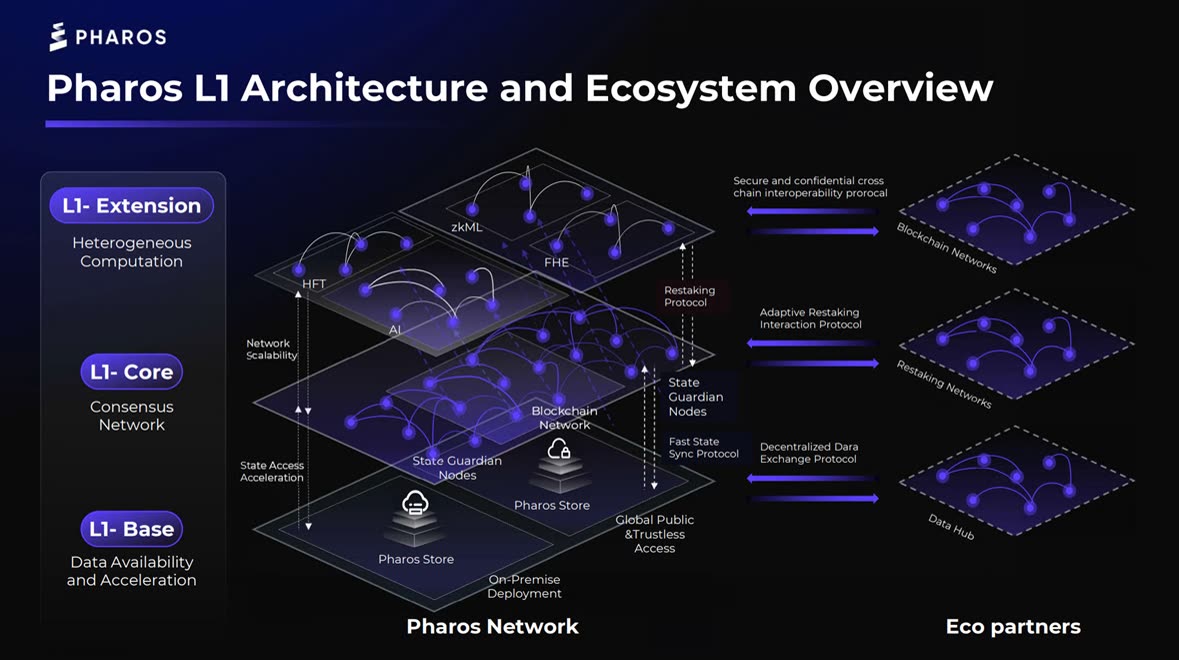
In contemporary digital economies, software agents process vast streams of data, optimize workflows, and coordinate complex multi-party interactions across distributed networks. However, enabling these intelligent entities to move value onchain securely remains a formidable challenge.
Under the traditional EOA default model, transactions typically require a signature and pre-funded native gas. Yet ERC-4337 introduces account abstraction mechanisms, including Paymasters, which allow third parties to sponsor gas fees for smart account transactions. EIP-7702, meanwhile, allows EOAs to delegate execution to smart account code, providing more flexible account capabilities. Combined with programmable smart account logic, these mechanisms can support batch execution, permission management, and restricted authorization. Pharos focuses on protocol-level coordination for agent-scale workloads. These friction points limit a software agent's ability to operate continuously within preset strategies and permission boundaries.
An AI agent transaction is an onchain transaction initiated by an autonomous software agent and executed within predefined permission, execution, and security constraints.
A secure agent transaction generally follows a chain: off-chain intent understanding and planning, policy checks, on-chain authorization, gas sponsorship, parallel execution, settlement, then monitoring and auditing. Building toward this, Pharos is developing a dedicated payment plane and programmable gas model for the agentic economy—with core EVM execution and settlement already on mainnet, and gas sponsorship still in testnet or on the roadmap.
As automated applications proliferate across global markets, developers face pressing questions regarding how digital agents initiate, authorize, and finalize economic tasks without exposing systems to severe security vulnerabilities. Autonomous Agent Transactions depend heavily upon structured permission frameworks rather than absolute, unconstrained machine authority. Establishing reliable digital workflows requires clear cryptographic boundaries, deterministic execution paths, and predictable settlement mechanisms that operate smoothly within high-performance Layer 1 blockchain environments.
Core Architecture for Secure Digital Workflows
Executing decentralized operations efficiently demands a robust technical foundation that unifies identity management, authorization scopes, and execution planes. Modern agent-native networks tackle these requirements through modular execution pipelines and specialized cryptographic protocols. The following operational phases define how intelligent systems manage secure value movement onchain:
Task Initiation and Scope Definition: An intelligent software agent initiates a transaction based on predefined operational parameters, data triggers, or user-defined intent. Intent understanding, task decomposition, and path planning typically happen off-chain with the agent or an orchestrator; on-chain components handle authorization, execution, and settlement. The initiating agent does not hold unrestricted access to treasury funds; instead, it operates within strict programmatic boundaries defined by pre-established smart contract permissions and delegation limits.
Cryptographic Signing and Authorization Verification: Once an action is triggered, the system verifies the authorization scope through cryptographic signatures and decentralized identity credentials. The signing mechanism ensures the executing entity holds valid, restricted authorization for the specific task category—enforced through session keys, delegation credentials, spending limits, and allowlists—preventing unauthorized fund transfers or unexpected protocol interactions. For example, session keys can limit an agent's permissions to specific time periods, transaction types, or spending amounts, reducing the security risks associated with long-term authorization.
Execution and Gas Sponsorship: After successful verification, the network processes the transaction through optimized parallel execution layers. At the application layer, agents can already sponsor gas via ERC-4337 Paymasters and similar mechanisms. Pharos aims to lift sponsorship strategy, auditing, and settlement coordination to the protocol level—capabilities currently in testnet or on the roadmap.
Failure Handling and Exception Management: When network congestion, smart contract reverts, or slippage thresholds occur, application-layer or smart-contract logic can trigger failure handling, rollback, and alerting; the agent orchestrator monitors and decides whether to retry or pause. It is important to distinguish between onchain transaction reverts and offchain task retries. Smart contracts handle execution failures and state reverts, while offchain orchestrators determine whether to resubmit a task based on error types, retry policies, and risk limits. Failed transactions trigger designated error handlers, notifying monitoring systems and logging diagnostic details without halting the entire operational pipeline.
Engineering Resilient Decentralized Frameworks
Building reliable infrastructure for intelligent software applications requires balancing high transaction throughput with strict security guarantees. Monolithic blockchain networks often struggle to maintain consistent block times and low latency under heavy computational loads, leading to transaction timeouts and failed execution states. In contrast, modular Layer 1 networks improve concurrency through asynchronous pipelines and related designs, though actual capacity depends on network configuration and load conditions.
Security in automated financial ecosystems extends beyond simple signature validation. It involves continuous monitoring of execution paths, state validation, and strict adherence to programmatic spending limits. Developers implement multi-layered validation checks that inspect transaction payloads before broadcast, ensuring that anomalous behavior or unexpected contract states trigger immediate suspension protocols. Such safeguards protect institutional assets and user funds while maintaining high processing speeds.
For agents handling multi-step financial operations, the underlying execution architecture is equally important. High-concurrency workloads may involve multiple smart contract calls, asset state updates, and liquidity operations. Networks therefore need to do more than process individual transactions efficiently; they must also support the coordination of complex execution tasks.
Pharos uses an EVM-compatible deep parallel execution and base settlement architecture. This layered separation of execution and settlement is designed for high-frequency agent workloads, with specific capabilities distinguished across mainnet, testnet, and roadmap. Within this modular paradigm, Pharos aims to deliver high throughput and predictable settlement for agent workloads under its parallel EVM architecture—measured against official benchmarks and live mainnet data.
Expanding the Horizons of Decentralized Finance
The convergence of artificial intelligence and distributed ledger technology opens unprecedented opportunities for real-world asset tokenization and automated financial workflows. As decentralized networks mature, institutional participants demand robust settlement layers that support complex financial instruments, private credit vaults, and automated treasury management. Pharos's mainnet provides EVM-compatible execution and base settlement; enterprise-grade agent capabilities such as gas sponsorship, agent accounts, and KYA remain in testnet or on the roadmap.
Real-world asset integration requires seamless interoperability between traditional financial databases and decentralized ledgers. Through dedicated payment planes and high-throughput consensus mechanisms, Pharos enables automated systems to interact with tokenized assets, liquidity pools, and cross-border settlement rails efficiently. This capability transforms theoretical concepts into practical operational tools, allowing enterprise systems to manage liquidity and execute recurring payments and settlement processes within preset strategies and human-oversight boundaries.
Ecosystem collaboration remains vital for establishing industry standards and interoperable protocols. Industry alliances and joint research initiatives help developers refine cryptographic standards, improve cross-chain communication, and enhance regulatory compliance frameworks. By fostering an open, developer-friendly environment, Pharos empowers global enterprises to build next-generation financial applications that integrate artificial intelligence smoothly into core business operations. Furthermore, Pharos plans to collaborate with ecosystem partners to advance onchain liquidity.
Conclusion
The advancement of decentralized technology relies on creating intelligent infrastructure capable of supporting autonomous software systems safely and efficiently. Through innovative architectural designs, programmable gas models, and robust authorization frameworks, modern blockchain networks solve the fundamental challenges of agentic value transfer. Beyond execution speed, the long-term viability of onchain systems requires deep regulatory compliance, cross-chain liquidity integration, and predictable economic incentives for institutional adoption.
As global enterprise participation accelerates, Pharos continues to drive the development of scalable, secure, and resilient solutions that redefine how digital assets and tokenized assets move across open networks. Exploring these structural advancements offers valuable technical insights into future financial architectures, automated corporate treasuries, and decentralized business workflows.
Learn more about the underlying technology, developer tools, and ecosystem developments by visiting the website https://www.pharos.xyz/
Pharos
Pharos
Legal Disclaimer:
EIN Presswire provides this news content "as is" without warranty of any kind. We do not accept any responsibility or liability for the accuracy, content, images, videos, licenses, completeness, legality, or reliability of the information contained in this article. If you have any complaints or copyright issues related to this article, kindly contact the author above.
