

Autonomous software systems are beginning to execute financial transactions within preset strategies and permission boun
News originally published by
EIN Presswire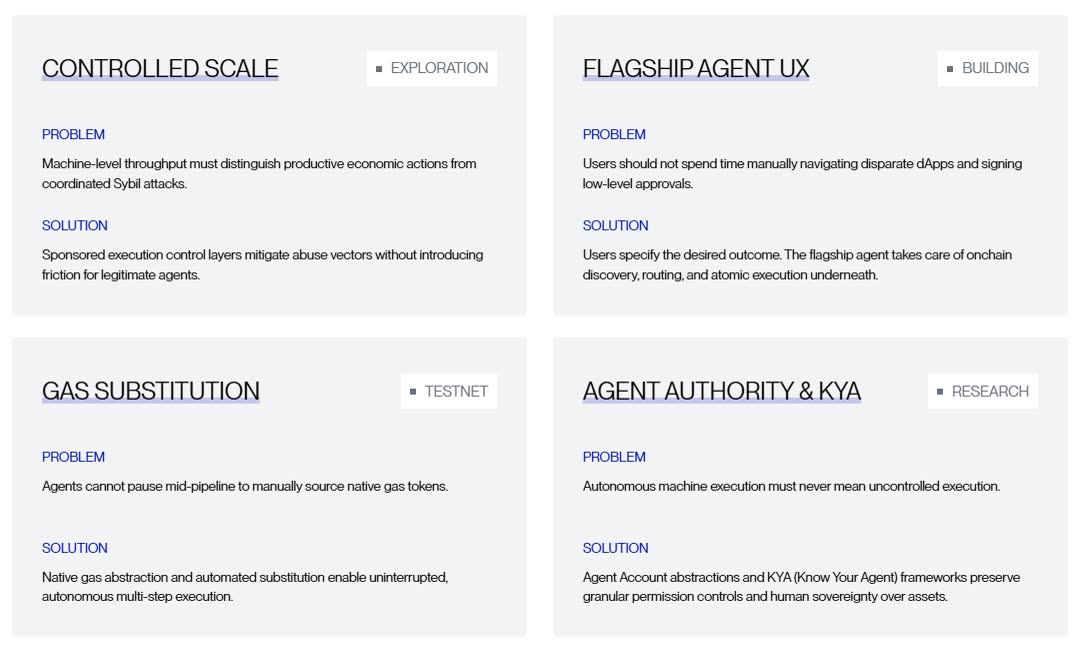
To bridge this operational gap, infrastructure design requires dedicated mechanisms for machine-to-machine value transfer. Pharos's design goal is to integrate protocol-level programmable gas and a payment plane; mainnet currently provides EVM-compatible execution and base settlement, while gas sponsorship and related capabilities in testnet validation or roadmap planning. The goal of AI Agent onchain payments is to reduce upfront gas and incremental manual operation under controlled authorization and sponsorship strategies.
Application-layer solutions already support some of these functions through mechanisms such as smart accounts and Paymasters. Pharos is exploring how these capabilities can be coordinated further at the infrastructure level, bringing execution, gas management, and settlement into a more integrated framework for agent workloads. This is an architectural direction, rather than a claim that all of these capabilities are already live on Pharos.
Understanding how these payment systems function requires looking beyond simple token transfers. A complete financial lifecycle for software agents encompasses: off-chain intent understanding and planning → transaction simulation and policy checks → on-chain authorization (spending limits / allowlists / session keys / KYA) → gas sponsorship → parallel execution → deterministic settlement and monitoring audit. General-purpose blockchain layers handle basic execution, but lack unified protocol-level identity, authorization, gas sponsorship, and settlement coordination; application-layer solutions already cover part of the need. Specialized infrastructure addresses this limitation by embedding dedicated components directly into the base layer.
Identity verification and authorization serve different purposes in this process. Identity verification establishes who an agent represents or who created it, while authorization defines what the agent can do, how much it can spend, and under which conditions it can act.
The Complete Onchain Payment Lifecycle
Financial transactions executed by software entities differ fundamentally from traditional peer-to-peer transfers or human-initiated decentralized finance interactions. A human user typically evaluates a transaction, reviews gas fees, signs a cryptographic payload via a wallet extension, and broadcasts the transaction. Software agents require an automated pathway that eliminates manual friction while maintaining rigorous security controls.
The payment lifecycle begins with cryptographic identity attribution. The agent identity (KYA) framework is a research direction for Pharos; mainnet currently provides base EVM accounts and contract capability, while the complete Agent identity standard remains on the roadmap. Once identity is secured, the authorization phase defines operational boundaries. These authorization constraints can be implemented by smart accounts, wallets, or application contracts; Pharos's goal is to coordinate Agent identity, policy, and settlement at the protocol level, but it must be clarified which parts are mainnet / testnet / roadmap.
For example, an automated procurement agent could be authorized to transact only with approved purchases, subject to per-transaction and daily spending limits. Mechanisms such as session keys can further restrict permissions by time, contract, or permitted operation, reducing the need for a human signature on every transaction.
Execution follows authorization. During this phase, the agent initiates a transaction based on predefined computational triggers, such as fulfilling a supply chain data request or settling an invoice. Before submission, the transaction can also undergo simulation and policy checks to identify issues such as insufficient balances, mismatched permissions, or potential contract execution failures. Finally, settlement records the transfer permanently on the ledger, updating state variables across distributed nodes. The complete payment lifecycle is therefore more than simply initiating a transaction and completing a transfer. It is a coordinated process covering identity, permissions, fees, execution, and outcome verification. Each of these four phases requires automated coordination to ensure that automated economic activity proceeds reliably without human oversight.
Distinguishing Execution from Payment Architecture
A common point of confusion in decentralized systems involves conflating transaction execution with the broader payment architecture. Standard execution layers merely process state changes and record data on blocks. They verify signatures, check balances, and execute smart contract bytecode. However, processing a transaction is only a fractional component of a complete financial workflow.
Payment architecture encompasses the economic logic governing why, when, and how funds move between parties. The traditional EOA model treats transactions as isolated signed events, which is inefficient for high-frequency micro-transactions; ERC-4337 batching and EIP-7702 delegation have already mitigated part of the issue. If an agent must constantly wait for human approval or manually maintain separate token balances for network fees, operational efficiency collapses.
Specialized Layer 1 networks designed specifically for machine economies solve this structural limitation. Pharos's architecture separates base execution from payment routing, with the goal of coordinating gas sponsorship and settlement at the protocol layer. Current mainnet provides base execution and settlement, while native payment-layer capabilities remain in the testnet validation or roadmap phase. The incremental value of this approach compared with application-layer solutions such as ERC-4337 Paymasters remains an area for further technical evaluation. The architectural direction is to bring transaction execution, fee management, and settlement coordination into closer alignment with the needs of agent workloads, rather than requiring each application to manage every component independently.
Programmable Gas and Frictionless Settlement
Transaction fees represent one of the most persistent operational hurdles for decentralized applications. Under the traditional EOA model, executing accounts need native gas; ERC-4337 Paymaster can sponsor fees, but unified cross-dApp policy and audit still require coordination. Pharos aims to provide unified payment policy at the protocol level.
Gas sponsorship refers to a mechanism through which a designated sponsor or payment component covers the network fees required for a transaction, so that users or agents do not need to directly hold or spend the chain's native token for every transaction. Within ERC-4337, a Paymaster is one application-layer component that enables this functionality.
Programmable gas mechanisms are designed to reduce this operational vulnerability; related capabilities are in testnet validation or roadmap phase on Pharos. By decoupling gas payment from the primary transaction flow, networks allow automated systems to manage fee allocation according to predefined rules, and explore alternative asset-based payment or settlement options where supported by the underlying design. Within the Pharos architecture, this capability ensures that software agents maintain continuous operational uptime without maintaining idle capital reserves solely for network fees.
Furthermore, settlement finality determines how quickly a transaction becomes immutable. In machine-to-machine economies, high latency creates settlement risk, particularly when agents execute time-sensitive procurement tasks or data exchanges. The consensus mechanism and finality model determine when a transaction is considered confirmed and under what conditions it can no longer be reverted. For automated transactions, predictable confirmation times and clear finality rules help agents determine when to deliver services, release digital assets, or proceed with subsequent operations.
Real-World Asset Integration and RealFi Markets
As autonomous economic systems mature, their utility extends beyond digital-native tokens into tangible economic sectors. RealFi bridges decentralized finance with physical commerce, applying cryptographic settlement to real-world assets such as supply chain logistics, equipment leasing, and infrastructure financing. Developers utilizing Pharos can build applications that securely connect decentralized finance with high-value physical assets.
In these scenarios, onchain payments can serve as more than a way to transfer funds. They can also become part of automated asset management and commercial workflows. For example, agents could trigger payments, distribute yield, or initiate other onchain operations based on contractual terms, asset conditions, or predefined business rules.
Software agents deployed in industrial environments frequently interact with Internet of Things sensors, automated warehousing systems, and commercial billing platforms. These agents require reliable onchain settlement rails to process invoices, pay for utility consumption, and manage asset depreciation tracking autonomously. By connecting decentralized execution environments with tangible economic sectors, the Pharos architecture creates scalable channels for industrial automation.
Institutional adoption within these high-value markets depends heavily on compliance, security, and predictability. Enterprise deployment requires strict adherence to regulatory frameworks, robust data privacy standards, and verifiable audit trails. Decentralized infrastructure designed for industrial applications needs to account for these requirements across account permissions, transaction records, data handling, and compliance workflows, enabling enterprises to adopt the technology while balancing decentralization, transparency, and regulatory requirements.
Conclusion
The integration of autonomous software into global economic workflows necessitates a fundamental redesign of blockchain infrastructure. Moving beyond human-centric paradigms requires specialized layers that handle identity, authorization, programmable gas, and rapid settlement seamlessly. By addressing the distinct requirements of machine-to-machine transactions, modern networks establish a reliable foundation for the emerging agentic economy.
Projects operating in this domain continue to refine the operational mechanics of decentralized finance, bridging the gap between computational automation and real-world financial settlement. As Pharos expands its infrastructure capabilities, the ongoing development of purpose-built Layer 1 architectures signals a maturation phase for blockchain technology. Enterprise teams building within the network benefit from dedicated tools tailored for autonomous financial operations. More information regarding these developments and technical documentation can be found directly on the official platform at https://www.pharos.xyz/
Pharos
Pharos
Legal Disclaimer:
EIN Presswire provides this news content "as is" without warranty of any kind. We do not accept any responsibility or liability for the accuracy, content, images, videos, licenses, completeness, legality, or reliability of the information contained in this article. If you have any complaints or copyright issues related to this article, kindly contact the author above.
